
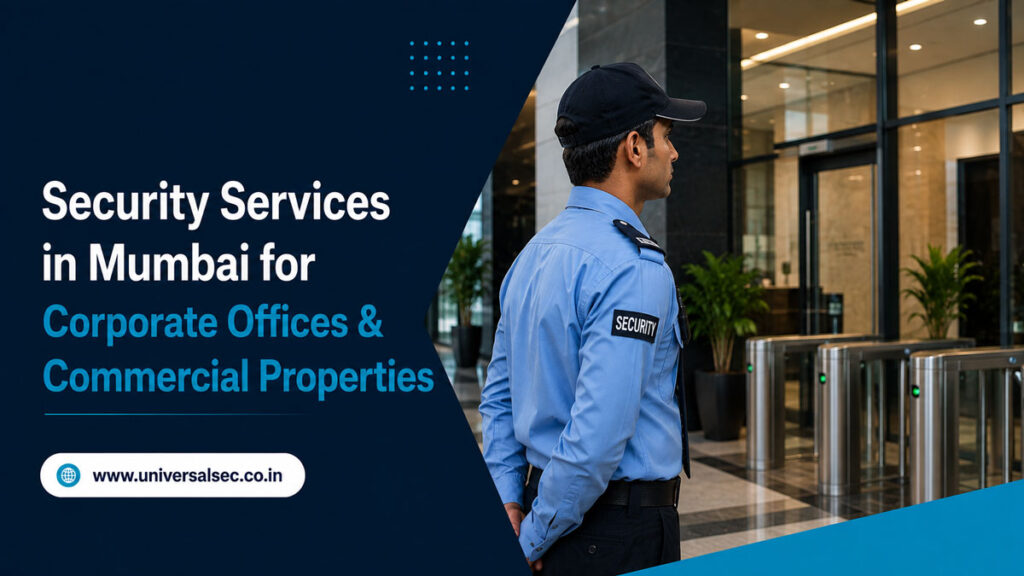
Security services in Mumbai are often required to manage busy office buildings, commercial properties, business parks, warehouses and other high-traffic premises. These sites can have employees, visitors, vendors, delivery personnel and vehicles moving through the property every day.
A suitable security arrangement should therefore do more than place guards at an entrance. It should address access control, visitor management, supervision, incident reporting, parking, emergency procedures and the specific operating pattern of the property.
For corporate offices and commercial properties in Mumbai, the right deployment depends on the site’s layout, working hours, number of access points, workforce size and security risks. This guide explains what businesses should consider when planning professional security services in Mumbai.
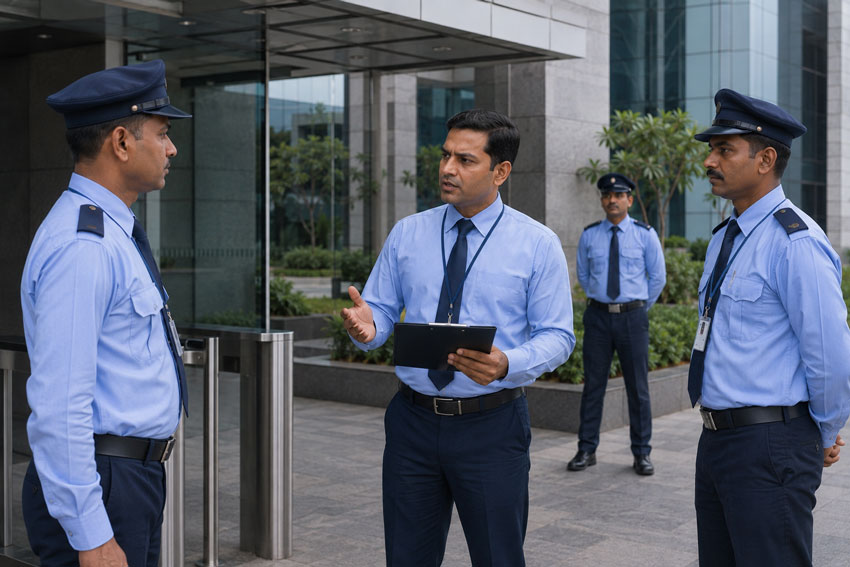
Why Corporate and Commercial Properties in Mumbai Need Planned Security
Commercial properties can experience significant movement throughout the day. Employees may arrive in shifts, visitors may come for meetings, vendors may require access, and delivery vehicles may enter loading areas.
A security team helps implement the property’s established access and safety procedures.
However, the number of guards required should not be decided simply by the size of a building. A smaller property with several entry points may require more active access management than a larger building with a single controlled entrance.
A proper assessment should consider:
- Number of entry and exit points
- Employee strength
- Visitor volume
- Operating hours
- Shift requirements
- Vehicle movement
- Parking areas
- Delivery and loading zones
- Restricted areas
- Existing CCTV systems
- Access-control systems
- Emergency exits
- Perimeter layout
This information helps create a deployment plan suited to the property rather than using a generic guard arrangement.
Security Services for Corporate Offices in Mumbai
Corporate offices have a different security environment from factories or residential societies. The focus is often on controlled access, visitor management, employee movement and maintaining a professional front-of-house experience.
1. Employee Access Management
Security personnel can help manage designated entry points according to the company’s access policies.
Depending on the office, guards may work alongside access cards, biometric systems, turnstiles or other access-control technology.
Their responsibilities should be clearly defined.
For example, the security team may need to:
- Monitor designated entry points
- Follow employee access procedures
- Identify unauthorised access attempts
- Direct employees and visitors appropriately
- Escalate access-related issues
- Maintain required records
Security personnel should not be expected to make decisions that fall outside the company’s established procedures.
2. Visitor Management
Corporate offices may receive clients, candidates, consultants, vendors and service providers throughout the day.
A structured visitor process can help maintain controlled access without creating unnecessary delays.
Depending on the company’s system, security personnel may assist with:
- Visitor identification
- Entry registration
- Visitor badges
- Appointment verification
- Vendor access
- Visitor exit records
- Direction to reception or meeting areas
The process should be designed around the organisation’s existing reception and access-control procedures.
3. After-Hours Security
Some Mumbai offices operate beyond traditional business hours.
IT companies, financial businesses, BPOs, shared offices and other organisations may have employees or contractors entering the premises early in the morning or late at night.
Security deployment should account for these operating patterns.
After-hours procedures may include controlled entry, visitor verification, monitoring of restricted areas and escalation of unusual activity.
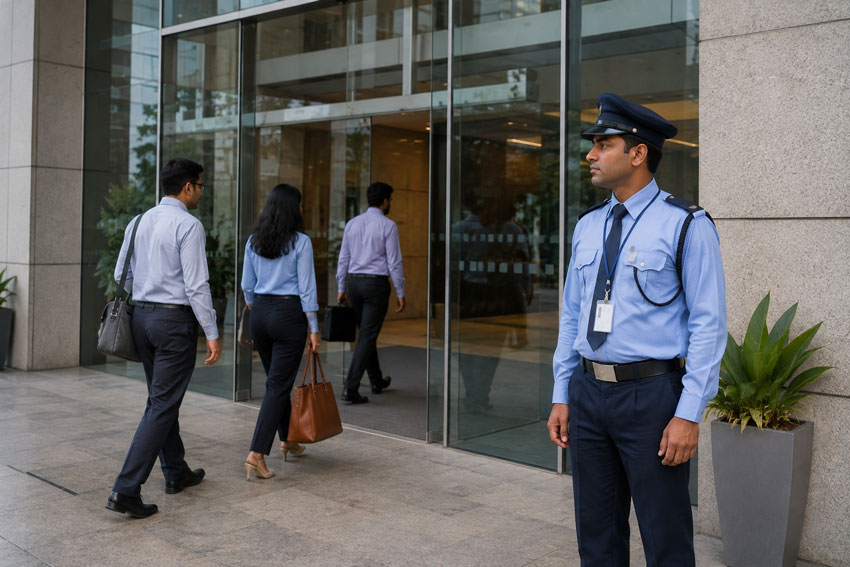
Security Services for Commercial Properties in Mumbai
Commercial properties can include office buildings, retail properties, business centers, mixed-use developments and other managed premises.The security requirements can vary considerably depending on the type of property.
1. Entrance and Lobby Security
The main entrance is often the first point of contact for employees and visitors.
Security personnel may help control access, direct visitors and monitor unusual activity.
For premium commercial properties, the security team’s presentation and communication style can also influence the visitor experience.
Professional conduct, clear communication and proper site knowledge are therefore important.
2. Parking and Vehicle Management
Large commercial properties can experience considerable vehicle movement during peak hours.
Security personnel may be responsible for implementing site-specific parking and vehicle-entry procedures.
These may include:
- Employee vehicle entry
- Visitor parking
- Delivery vehicles
- Service vehicles
- Restricted parking
- Loading and unloading areas
- Exit management
The security team should follow documented procedures rather than relying on inconsistent decisions at the gate.
3. Delivery and Vendor Access
Commercial properties frequently receive deliveries and service personnel.
Security procedures should establish how vendors are verified, where they are permitted to go and whether their movement needs to be recorded.
Separate procedures may be useful for:
- Courier personnel
- Maintenance contractors
- Cleaning teams
- Food delivery personnel
- Equipment suppliers
- Facility-management vendors
Clear instructions reduce confusion and make access management more consistent.
Security for Mumbai Business Parks and Office Campuses
Large office campuses can have multiple buildings, entrances, parking zones and service areas. A single security post may not be sufficient to manage such a property.
Depending on the site, security deployment may include:
- Main entrance security
- Employee entrance
- Visitor entrance
- Vehicle gates
- Parking areas
- Service entrances
- Perimeter patrols
- Building-level security
- Control-room support
The exact arrangement should be determined through a site assessment.
1. Managing Multiple Access Points
Every additional access point can create another potential security-management requirement.
Before deployment, the organisation should identify which entrances need continuous coverage and which can be controlled through defined operating hours or technology.
This can help avoid both overstaffing and gaps in coverage.
2. Coordinating With Facility Management
Security personnel often work alongside facility-management teams.
Clear communication between security supervisors, facility managers and client representatives can make it easier to address operational issues.
The responsibilities of each team should be documented so that security personnel know whom to contact when an issue requires escalation.
3. Security Services for Commercial Buildings With 24-Hour Operations
Not every commercial property operates on a standard nine-to-five schedule.
Some properties require security coverage throughout the day and night.
In such cases, the deployment calculation should account for:
- Number of security posts
- Shift timings
- Weekly offs
- Leave
- Replacement requirements
- Supervisor coverage
- Night-time access procedures
- Emergency escalation
A single guard should not be treated as equivalent to continuous coverage for an entire security post.
The agency and client should agree on the required coverage model before the contract begins.
4. Check Applicable Licensing
Private security agencies in India are regulated under the Private Security Agencies (Regulation) Act, 2005. The Ministry of Home Affairs states that private security agencies operate under a licensing framework administered through the relevant State or UT authorities.
Before appointing an agency, ask for the applicable licence and other relevant documentation.
For Mumbai and Maharashtra, organisations should also consider the applicable state-level regulatory framework for private security guards. The Maharashtra Labour Department states that the Maharashtra Private Security Guards legislation applies to private security guards working in covered factories and establishments, subject to the Act’s scope and exclusions.
5. Evaluate Recruitment and Training
Ask how guards are recruited, screened and prepared for deployment.
Relevant areas may include:
- Identity and document verification
- Background screening
- Basic security training
- Site induction
- Access-control procedures
- Incident reporting
- Emergency procedures
- Communication skills
The training should match the actual duties assigned at the property.
6. Assess Supervisor Support
A professional deployment needs appropriate supervision.
Ask:
- Who is the site supervisor?
- How often will the site be inspected?
- Who handles operational complaints?
- Who is the escalation contact?
- How are performance issues addressed?
- How are attendance issues monitored?
Supervision becomes especially important when several guards are deployed across multiple posts or shifts.
7. Understand Guard Replacement Procedures
Absenteeism can create an immediate gap in security coverage.
Before signing a contract, ask what happens when a guard is unavailable because of leave, illness, resignation or another reason.
The agency should explain how replacement personnel are arranged and how continuity of coverage is maintained.
Need Security Services in Mumbai?
If you are evaluating security services in Mumbai for a corporate office, commercial building, business park, warehouse or other facility, Universal Personnel Security Training & Allied Services can help assess the property’s requirements and determine a suitable security deployment approach.
Call Us: +91-231-2667429
Mail Us: hr@universalsec.co.in
Need Security Services In Mumbai Explore Our Services Now.
How to Plan Security Deployment for a Mumbai Property
Once the basic requirements are understood, the next step is to create a practical deployment plan.
Step 1: Map the Property
Identify:
- Main gates
- Secondary entrances
- Parking areas
- Reception
- Loading zones
- Restricted areas
- Emergency exits
- Perimeter areas
A simple site map can make security planning easier.
Step 2: Identify Movement Patterns
Review when employees, visitors, vendors and vehicles enter and leave.
Peak periods may require different arrangements from quieter periods.
For example, the morning employee rush may require additional attention at the main entrance, while delivery and vendor movement may be more significant later in the day.
Step 3: Define Security Posts
Each post should have a clear purpose.
Instead of simply saying “four guards are required,” define the actual responsibilities:
| Post | Typical Responsibility |
|---|---|
| Main entrance | Employee and visitor access |
| Vehicle gate | Vehicle movement |
| Lobby | Visitor management |
| Service entrance | Vendor and delivery access |
| Parking | Vehicle and area monitoring |
| Perimeter | Patrol or designated monitoring |
The actual responsibilities will depend on the property.
Step 4: Define Escalation Procedures
Security personnel should know whom to contact when they encounter an issue.
The escalation chain might involve:
Security Guard → Supervisor → Facility Manager → Client Management
The exact structure should be agreed upon by the organisation.
Technology and Security Personnel
Modern commercial properties often use technology alongside security personnel.
Common systems may include:
- CCTV
- Access-control systems
- Biometric authentication
- Visitor-management software
- Vehicle-management systems
- Intercom systems
- Alarm systems
Technology can improve visibility and record-keeping, but it does not automatically eliminate the need for trained personnel.
A guard may still be required to manage physical access, interact with visitors, follow procedures and respond according to the site’s escalation plan.
The best approach is usually to determine how technology and manpower should work together.
How Much Security Manpower Does a Mumbai Office Need?
There is no standard guard-to-office-size ratio that works for every property.
A better approach is to assess the actual operating requirements.
Consider:
- Number of entrances
- Number of buildings
- Employee strength
- Visitor traffic
- Vehicle movement
- Operating hours
- Number of shifts
- Security-sensitive areas
- Existing security technology
- Perimeter requirements
For example, a small office with one controlled entrance may have very different requirements from a multi-building business campus with several gates and underground parking.
The objective should be adequate coverage, not simply deploying the maximum possible number of guards.
Common Mistakes When Hiring Security Services in Mumbai
Choosing Only the Lowest Quotation
A low quotation may not include the same level of supervision, training, replacement coverage or service scope as another proposal.Compare quotations on a like-for-like basis.
Not Conducting a Site Assessment
Security requirements should be based on the property rather than a generic manpower package.
Ignoring After-Hours Requirements
A property that operates late at night needs a deployment plan that accounts for those hours.
Failing to Define Guard Duties
Unclear responsibilities can create confusion during routine operations and incidents.
Not Asking About Replacement Guards
Ask how the agency handles absence before signing the contract.
Treating CCTV as a Complete Replacement for Security Personnel
CCTV can support monitoring, but physical access management and on-site response may still require trained personnel.
Not Establishing an Escalation Process
Everyone involved should know who receives incident reports and who has authority to make operational decisions.
Questions to Ask a Security Agency Before Hiring
Before finalising a security agency, ask the following:
- Is the agency appropriately licensed for the required operations?
- How are guards recruited and screened?
- What training do guards receive?
- Is site-specific induction provided?
- Who supervises the deployed team?
- How often are site inspections conducted?
- How are guard absences handled?
- Are replacement personnel provided?
- How are incidents reported?
- Who is the escalation contact?
- What is included in the quotation?
- Are uniforms and supervision included?
- How are shift requirements handled?
- How frequently is the deployment reviewed?
Getting these details in writing makes it easier to compare providers.
Frequently Asked Questions
Q1. What security services are commonly required by corporate offices in Mumbai?
Corporate offices commonly require access control, visitor management, employee entry monitoring, parking management, vendor access control and security supervision. The exact services depend on the building, operating hours and site requirements.
Q2. How many security guards does a commercial property in Mumbai need?
There is no universal number. The requirement depends on the number of access points, shifts, visitor traffic, vehicle movement, property layout and security procedures. A site assessment should be completed before finalising manpower.
Q3. How do I choose a security company in Mumbai?
Compare licensing, recruitment, training, supervision, replacement procedures, reporting, relevant experience and service scope. Do not select an agency based solely on the lowest quotation.
Q4. Do corporate offices need security guards if they have CCTV?
CCTV can support monitoring and recording, while security personnel can manage physical access, interact with visitors and implement site procedures. The two can complement each other.
Q5. What should a security guard do at a corporate office?
Duties may include access management, visitor handling, monitoring designated areas, following site procedures, recording required information and reporting incidents. Responsibilities should be clearly defined by the client.
Q6. Is PSARA licensing required for private security agencies in Mumbai?
Private security agencies are regulated under PSARA, and the Act establishes a licensing framework administered through the relevant State or UT authorities. Organisations should verify the agency’s applicable licence before appointment.
Q7. Can security services be customised for a commercial property?
Yes. Deployment can be planned around the property’s entrances, operating hours, visitor traffic, vehicle movement, restricted areas, technology and specific security requirements.
Q8. How often should a commercial property’s security deployment be reviewed?
It is useful to review deployment whenever the property changes significantly, such as when new entrances are added, operating hours change, occupancy increases or the site’s security systems are upgraded.
Conclusion
Choosing the right security services in Mumbai requires an understanding of how the property actually operates. Corporate offices and commercial buildings can have different requirements depending on their entrances, workforce, visitor traffic, vehicle movement, working hours and security systems.
A strong security plan combines appropriate manpower with clear procedures, supervision, technology and defined escalation channels.
Before selecting a provider, compare the complete service rather than just the monthly quotation. Verify applicable documentation, assess training and supervision, understand replacement procedures and ensure the deployment is designed around the property’s actual requirements.
For organisations in Mumbai, the right security arrangement should provide consistent access management and professional on-site support without creating unnecessary operational complexity.