

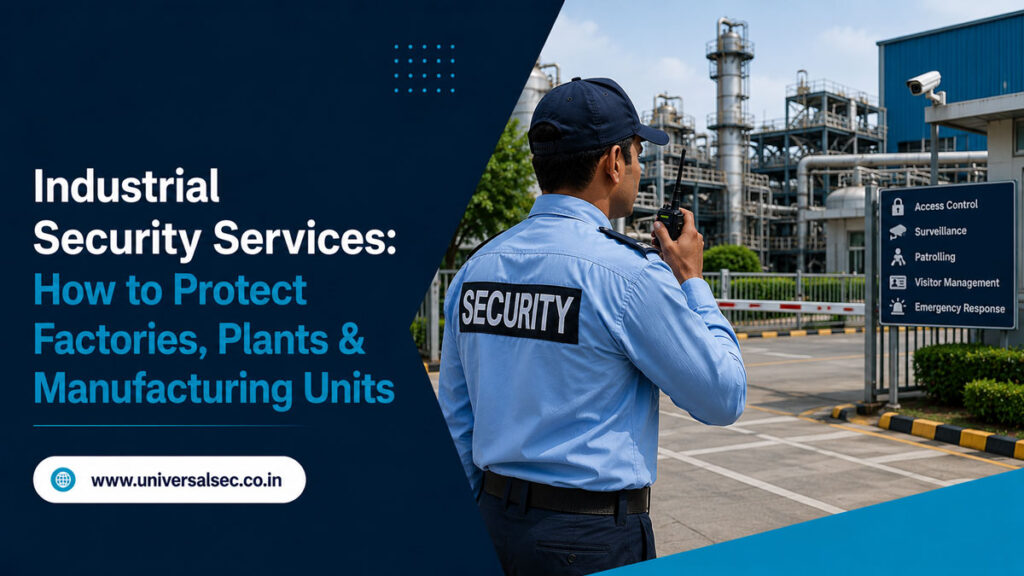
Industrial security services help factories, plants and manufacturing units protect people, machinery, raw materials, finished goods and critical operations. Industrial sites often have multiple gates, large perimeters, heavy vehicle movement, contractors, employees working in shifts and valuable equipment.
A practical security plan must therefore go beyond placing guards at the main entrance. It should combine trained security personnel, access control, surveillance, patrols, emergency procedures and clear reporting systems. This guide explains the key areas businesses should consider when planning security for an industrial facility.
Why Industrial Security Is Important
Factories and manufacturing units can face different risks depending on their location, operations and site layout. Common concerns include unauthorised entry, theft, material movement, trespassing, employee access and incidents around loading areas.
Professional security can help businesses manage:
- Employee and visitor entry
- Vehicle and gate access
- Contractor movement
- Material inward and outward movement
- Perimeter monitoring
- Warehouse and storage areas
- Parking and loading zones
- Incident reporting and emergency coordination
The exact security arrangement should be based on a site assessment rather than a fixed guard count.
Key Areas to Secure in an Industrial Facility
1. Main and Secondary Gates
Gates are critical control points. Security personnel can verify employees, visitors, contractors and vehicles according to the site’s approved procedures.
Secondary gates should not be overlooked. Depending on the facility layout, they may require separate guards, patrols or controlled access arrangements.
2. Perimeter and Boundary
Large industrial premises can have extensive boundaries that require regular monitoring. Security patrols can help identify unusual activity, damaged fencing, unauthorised access attempts or other concerns.
Patrol frequency should be determined according to the site’s layout and identified risks.
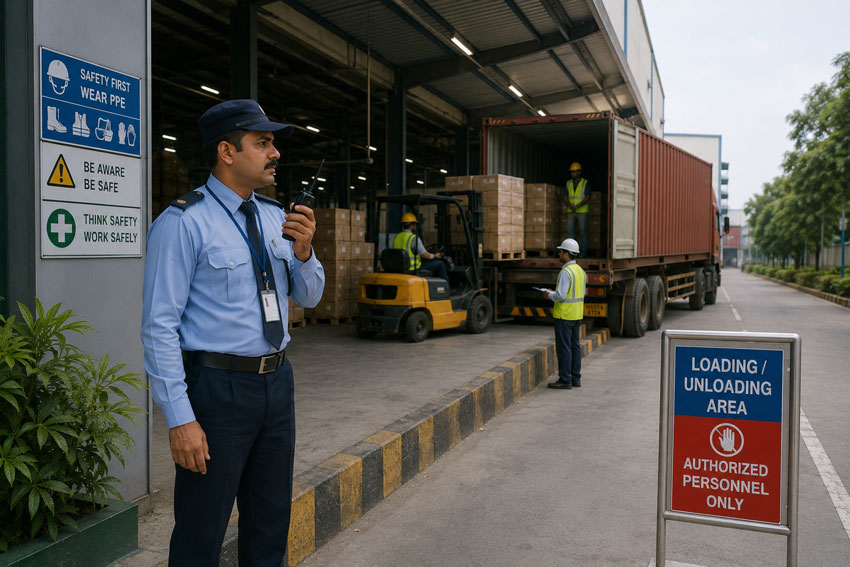
3. Loading and Unloading Areas
Factories regularly receive raw materials and dispatch finished products. Security personnel should follow documented procedures for vehicle entry, documentation, material movement and exit checks.
Clear responsibilities between security, stores and logistics teams can reduce confusion during busy operating periods.
Security Measures for Manufacturing Units
A strong industrial security system may include several complementary measures.
Access control: Establish clear rules for employees, contractors, visitors and vendors.
Visitor management: Record and manage visitors according to company procedures, including appropriate authorisation before access.
Vehicle management: Maintain appropriate entry and exit records and follow site-specific vehicle checking procedures.
Security patrols: Conduct scheduled or risk-based patrols around important areas.
CCTV monitoring: Where surveillance systems are installed, trained personnel can monitor relevant areas and report unusual activity.
Incident reporting: Security staff should record incidents, observations and important events so management can review them.
How Many Security Guards Does a Factory Need?
There is no universal number of guards suitable for every factory or plant. Deployment depends on factors such as:
- Number of entry and exit points
- Size of the premises
- Operating hours and shifts
- Perimeter length
- Employee strength
- Visitor and contractor movement
- Vehicle traffic
- Sensitive or restricted areas
- Existing CCTV and access-control systems
A site assessment can help determine where personnel are actually required and whether supervisory coverage is necessary.
Choosing the Right Industrial Security Agency
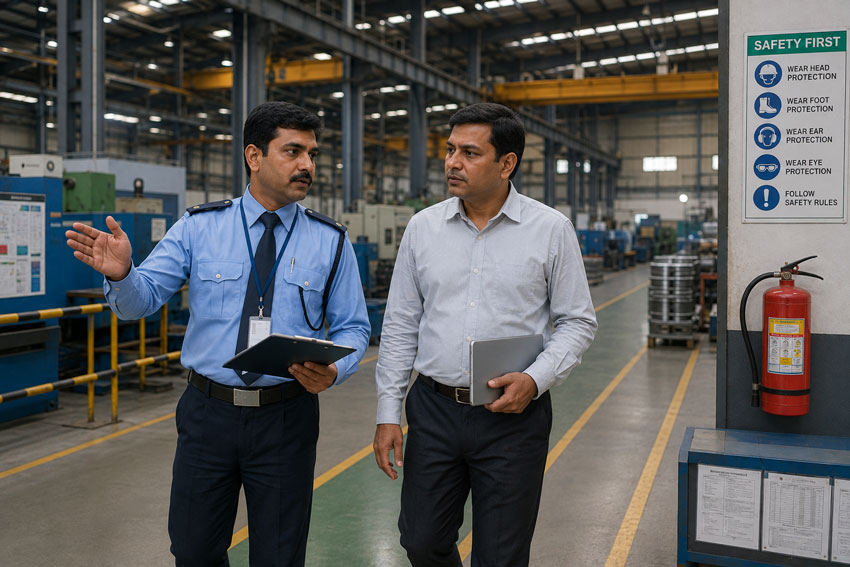
Businesses should evaluate a security agency based on more than its quoted price.
Before finalising a provider, consider:
- Applicable licences and regulatory compliance
- Guard recruitment and verification procedures
- Training and site-specific instructions
- Supervisor availability
- Attendance and replacement arrangements
- Incident reporting procedures
- Experience with similar operating environments
- Ability to maintain consistent deployment
The agency should also understand the facility’s operating procedures before guards are deployed.
Your Production Should Never Stop Because of a Security Gap
From the main gate to the warehouse and loading area, every part of your facility deserves the right level of protection. Talk to Universal about a security arrangement designed for your industrial environment.
Call Us: +91-231-2667429
Mail Us: hr@universalsec.co.in
Need Security Services In India Explore Our Services Now.
Common Industrial Security Mistakes
Some avoidable mistakes can weaken an otherwise well-planned security system:
- Focusing only on the main gate
- Ignoring perimeter vulnerabilities
- Not controlling contractor access
- Failing to document material movement
- Leaving security responsibilities unclear
- Choosing guards solely on cost
- Not reviewing incidents and security observations
- Failing to provide proper site instructions
Security should be treated as an ongoing operational function, not a one-time installation.
Frequently Asked Questions
Q1. What are industrial security services?
Industrial security services are security solutions designed for factories, plants, manufacturing units, warehouses and similar facilities. They can include access control, guarding, patrols, visitor management, vehicle control and security reporting.
Q2. What does an industrial security guard do?
Depending on the site, duties may include gate control, visitor verification, vehicle management, patrols, monitoring, reporting and following the facility’s security procedures.
Q3. How can factories prevent unauthorised entry?
Factories can use controlled access points, visitor procedures, employee identification, appropriate vehicle checks, perimeter patrols and surveillance systems where required.
Q4. Do manufacturing units need 24-hour security?
Not every facility has the same requirement. Businesses operating around the clock or holding valuable assets may require continuous coverage, while other sites may have different deployment needs.
Q5. How should a factory select a security agency?
Compare the agency’s compliance, guard verification, training, supervision, deployment capability and experience with industrial environments. The decision should not be based solely on price.
Q6. Can security guards manage material movement?
Security personnel can follow documented procedures for checking and recording material movement, provided their responsibilities are clearly defined by the facility management.
Conclusion
Protecting an industrial facility requires a coordinated approach to people, premises, vehicles, materials and daily operations. Businesses should assess their site carefully and select security personnel, procedures and supervision according to actual risks. Regular reviews can also help ensure that security arrangements continue to match changing operational requirements.