
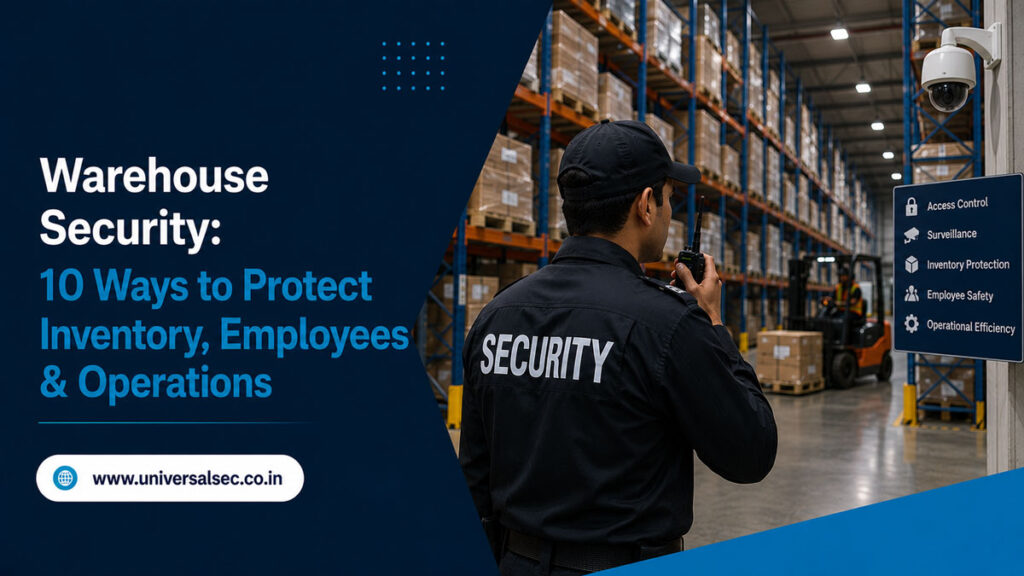
Warehouse security is essential for protecting inventory, employees, equipment and day-to-day operations. Warehouses often handle valuable stock, frequent vehicle movement, loading and unloading, contractors and multiple shifts, making security more complex than simply guarding the main entrance.
A practical warehouse security plan should cover the entire facility, from perimeter access and gates to storage areas and dispatch zones. This guide explains 10 practical ways to improve warehouse security and reduce avoidable risks without disrupting normal operations.
Why Warehouse Security Matters
A warehouse can contain valuable inventory and equipment while operating with a constant flow of people and vehicles. Uncontrolled access, poor material tracking or weak supervision can create security gaps.
Effective security can help organisations manage:
- Employee and visitor access
- Vehicle movement
- Inventory movement
- Loading and unloading
- Restricted areas
- Perimeter protection
- Emergency situations
- Security incidents and reporting
The right approach depends on the warehouse’s size, location, inventory, operating hours and internal procedures.
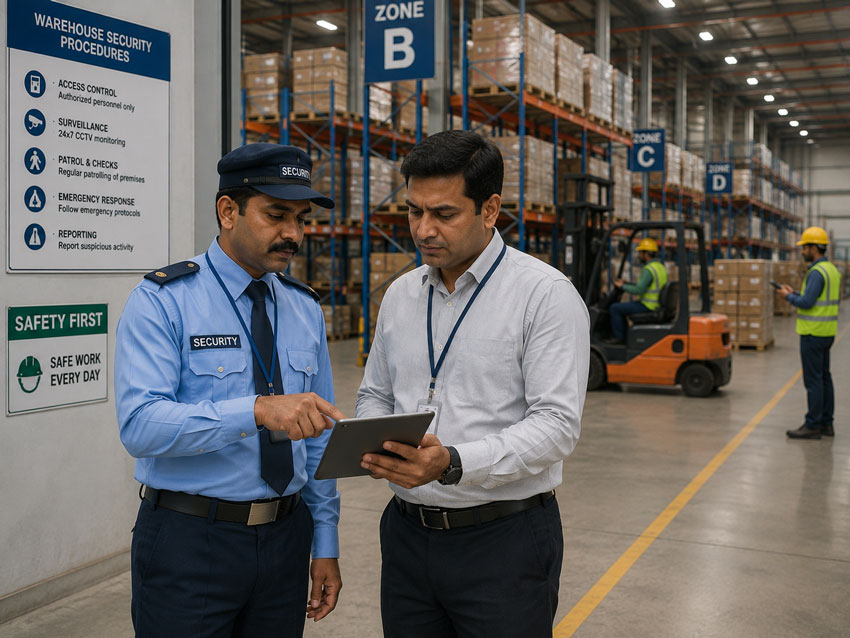
10 Ways to Improve Warehouse Security
1. Control Every Entry and Exit Point
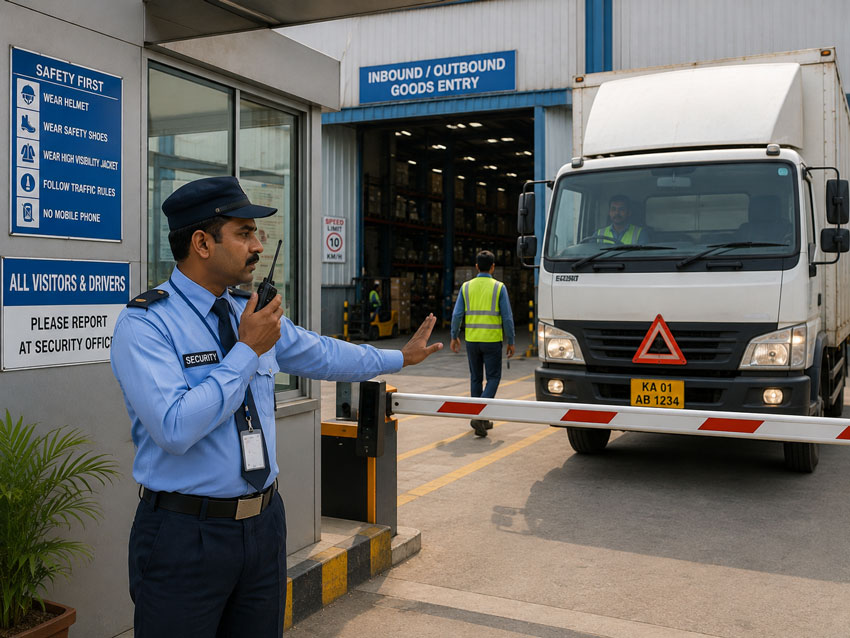
The main gate should not be the only security focus. Warehouses may have employee entrances, loading gates, emergency exits and service entrances.Clearly identify authorised access points and establish procedures for employees, visitors, vendors and contractors.
Security personnel should follow the warehouse’s approved access rules rather than relying on informal identification.
2. Maintain Proper Visitor Management
Visitors, vendors and contractors should enter through a defined process.
Depending on the organisation’s requirements, security personnel can:
- Verify visitor identity
- Confirm the purpose of the visit
- Contact the relevant employee
- Maintain visitor records
- Issue visitor identification where required
- Ensure appropriate exit procedures
A structured process helps prevent unknown individuals from moving freely around operational areas.
3. Strengthen Vehicle and Gate Security
Warehouses can experience significant vehicle movement throughout the day. Trucks, delivery vehicles, employee vehicles and vendor vehicles may all require access.
Security procedures should clearly define how vehicles are authorised, recorded and directed. Particular attention should be given to loading and unloading zones where vehicle and inventory movement happen simultaneously.
4. Monitor Inventory Movement
Security and warehouse teams should have clearly defined procedures for material entering and leaving the facility.Relevant documentation may include delivery records, dispatch documents, gate passes or other company-approved records.
Security personnel should understand what they are expected to verify and when they should refer an issue to stores, logistics or management.
5. Protect Loading and Unloading Areas
Loading areas can become busy and difficult to monitor during peak periods. They should have clearly defined access and movement procedures.Security personnel can help manage vehicle queues, authorised personnel and movement around loading zones while coordinating with warehouse staff.
The goal is to maintain control without unnecessarily slowing legitimate operations.
6. Secure Restricted and High-Value Areas
Not every area of a warehouse needs the same level of access.
Businesses may designate restricted areas for:
- High-value inventory
- Sensitive documents
- Equipment
- Hazard-controlled materials
- Administrative functions
Access should be limited according to company policy, with appropriate monitoring and authorisation.
7. Use CCTV as Part of a Wider Security System
CCTV can provide useful visibility across entrances, exits, storage areas, loading zones and other important locations.
However, cameras alone do not replace physical security procedures. Where CCTV is installed, organisations should define who monitors the system, how incidents are reported and how relevant footage is handled according to company policy.
8. Conduct Regular Security Patrols
Patrols can help identify unusual activity, unsecured doors, damaged fencing, lighting issues or other concerns that may not be visible from the main gate.
Patrol routes and frequency should be based on the warehouse layout and identified risks.
Supervisors can also review patrol records and observations to identify recurring issues.
9. Train Security Personnel for the Site
A guard familiar with a particular warehouse’s procedures is better positioned to perform assigned responsibilities consistently.
Site-specific instructions should cover:
- Entry and exit procedures
- Emergency contacts
- Restricted areas
- Material movement
- Vehicle handling
- Visitor procedures
- Incident escalation
Training should be supported by regular supervision and clear communication with facility management.
10. Maintain Incident Reporting and Review
Security incidents should not simply be dealt with and forgotten. Proper reporting can help management understand recurring problems.Reports may cover theft concerns, unauthorised access attempts, damaged property, suspicious activity, accidents involving security procedures or other significant observations.
Periodic reviews can help businesses identify where procedures need improvement.
Is Your Warehouse Secure at Every Gate, Not Just the Main One?
A warehouse can have strong security at the front gate and still have gaps elsewhere.
Universal Personnel Security Training & Allied Services can help organisations assess their premises and plan security support around access points, operations, manpower and site-specific requirements.
Call Us: +91-231-2667429
Mail Us: hr@universalsec.co.in
Need Security Services In India Explore Our Services Now.
How Many Security Guards Does a Warehouse Need?
There is no standard guard count that works for every warehouse.
Deployment may depend on:
- Number of gates
- Warehouse size
- Perimeter length
- Operating hours
- Number of shifts
- Vehicle movement
- Inventory value and sensitivity
- CCTV and access-control systems
- Required patrol coverage
A site assessment can help determine whether guards are required at fixed posts, mobile patrols, loading areas or other locations.
Choosing a Warehouse Security Agency
When selecting a security provider, businesses should look beyond the quotation.Check the agency’s applicable regulatory compliance, guard verification process, training standards, supervision arrangements and ability to maintain consistent deployment.
It is also useful to explain the warehouse’s operating procedures before deployment. This allows responsibilities to be defined clearly between security personnel, warehouse staff, logistics teams and management.
Common Warehouse Security Mistakes
Avoid these common gaps:
- Leaving secondary gates uncontrolled
- Allowing informal visitor access
- Poor vehicle-entry records
- Unclear material-checking responsibilities
- Ignoring perimeter areas
- Deploying guards without site-specific instructions
- Relying entirely on CCTV
- Failing to review security incidents
Warehouse security works best when people, procedures and technology support each other.
Frequently Asked Questions
Q1. What is warehouse security?
Warehouse security involves protecting inventory, employees, equipment and premises through measures such as access control, guarding, visitor management, vehicle control, patrols, surveillance and incident reporting.
Q2. How can warehouses prevent inventory theft?
Businesses can strengthen controls around entry and exit points, material movement, restricted areas, loading zones and inventory documentation. Security procedures should be aligned with warehouse operations.
Q3. Should warehouses have security guards 24/7?
It depends on operating hours, inventory, site risks and business requirements. Warehouses operating continuously or storing valuable inventory may require round-the-clock coverage.
Q4. How many guards are required for a warehouse?
The requirement depends on the number of gates, site size, shifts, perimeter, vehicle movement and security procedures. A site assessment is preferable to using a fixed manpower number.
Q5. Is CCTV enough for warehouse security?
CCTV can improve visibility, but it should generally work alongside access control, trained security personnel and clearly defined procedures.
Q6. What should I check before hiring a warehouse security agency?
Review applicable licensing and compliance, guard verification, training, supervision, deployment capability and experience with warehouse or industrial environments.
Conclusion
Warehouse security is most effective when it protects the entire operation rather than focusing on a single entry point. Access control, vehicle management, inventory procedures, patrols, surveillance, trained personnel and incident reporting should work together.
Regularly reviewing the arrangement can also help businesses respond to changes in inventory, workforce, operating hours and site layout.