
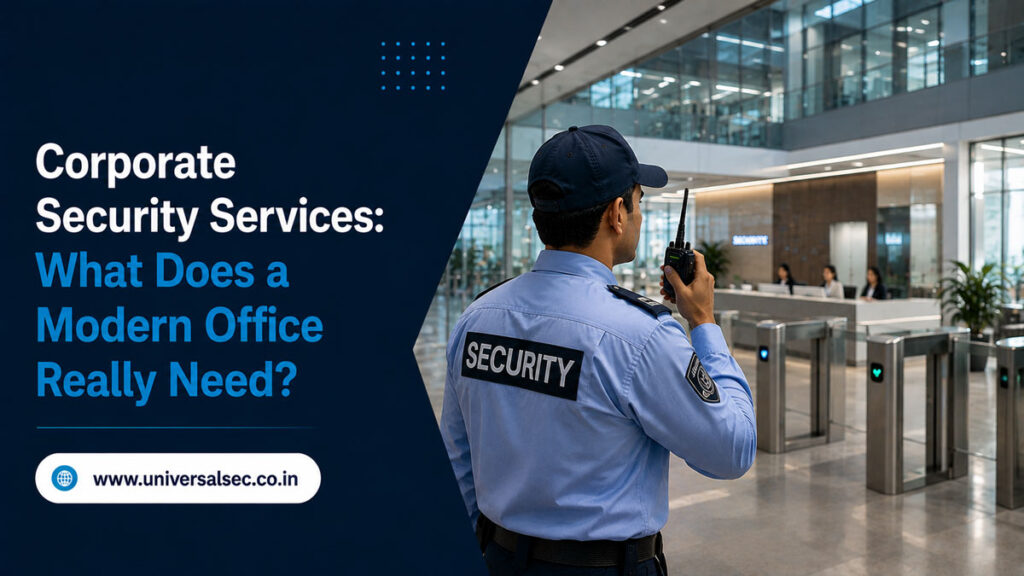
Corporate security services have become an important part of running a modern office. Today’s workplaces may have employees working across multiple shifts, visitors arriving throughout the day, vendors making deliveries, valuable equipment on-site and several access points that need monitoring.
A professional security setup is not simply about placing a guard at the entrance. It should combine trained personnel, access control, visitor management, surveillance, emergency procedures and regular supervision.

Why Modern Offices Need Corporate Security
Office security protects more than physical property. It also helps create a controlled and organised environment for employees, visitors and business operations.
Modern offices may need security support for:
- Employee entry and exit
- Visitor and vendor management
- Access to restricted areas
- Vehicle and parking control
- Reception and lobby security
- Delivery management
- CCTV monitoring
- Perimeter checks
- Emergency coordination
- Incident reporting
The right combination depends on the company’s premises, workforce, operating hours and security requirements.
1. Controlled Employee Access
Employee access should follow the organisation’s approved security procedures. Security personnel can monitor designated entry points and help ensure that only authorised individuals enter the workplace.
For offices with sensitive departments, server rooms, records areas or other restricted spaces, access can be managed according to the company’s internal policies.
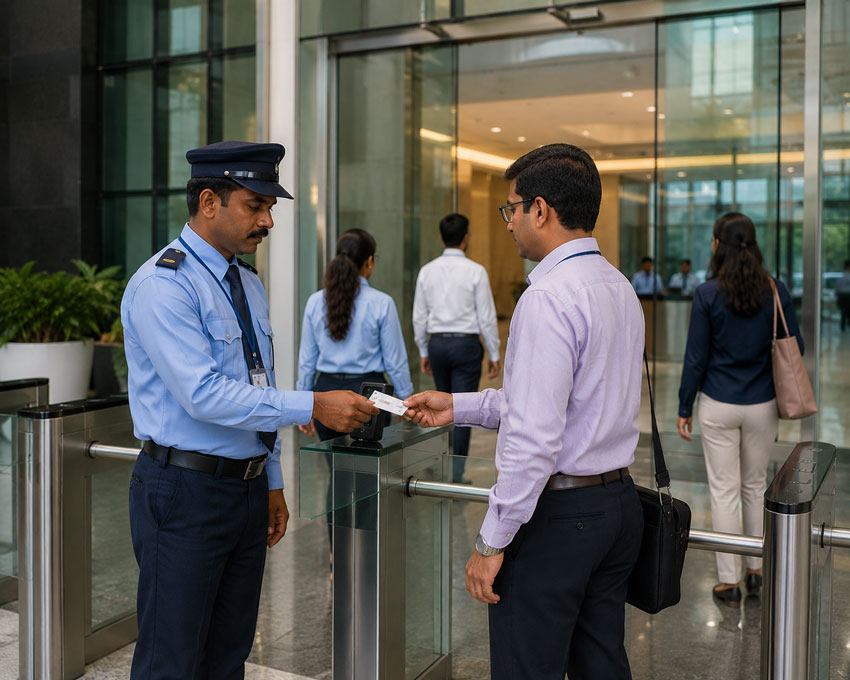
2. Professional Visitor Management
Corporate offices regularly welcome clients, candidates, vendors, contractors and business partners. A clear visitor-management process helps maintain security without making the workplace unnecessarily difficult to access.
Security personnel may:
- Verify visitor identity
- Confirm the purpose of the visit
- Contact the relevant employee
- Maintain visitor records
- Provide visitor identification where required
- Follow appropriate exit procedures
A professional approach should balance security with a positive first impression.
3. Reception and Lobby Security
The reception area is often the first point of contact for visitors. Security personnel can assist reception and administration teams with access verification and visitor coordination.
Large offices may also need separate procedures for employee entrances, visitor entrances, deliveries and service personnel.
4. Parking and Vehicle Management
Corporate campuses can experience heavy vehicle movement during opening hours, shift changes and visitor appointments.
Security teams can help manage:
- Employee parking
- Visitor parking
- Delivery vehicles
- Service vehicles
- Entry and exit points
- Vehicle movement within the premises
Clear procedures help reduce congestion while maintaining appropriate control.
5. Security for Restricted Areas
Not every office area should have unrestricted access.
Depending on the organisation, restricted areas may include:
- Server rooms
- Data centres
- Management offices
- Records rooms
- Storage areas
- Equipment rooms
Security personnel should understand which areas require additional access controls and whom to contact when access is unclear.
6. CCTV and Physical Security
CCTV can provide visibility across entrances, corridors, parking areas and other important locations. However, cameras should support rather than replace physical security.Security personnel can respond to situations requiring physical verification, access control or coordination with facility management.
Companies using CCTV should establish appropriate procedures for monitoring, incident reporting and handling footage according to their internal policies.
7. Delivery and Vendor Control
Modern offices receive regular deliveries, maintenance personnel and service providers. Uncontrolled service access can create unnecessary security gaps.
Security procedures should define:
- Where deliveries are received
- Who can authorise access
- Where vendors can move
- How service personnel are recorded
- When access should be escalated to management
This is particularly important for offices with multiple service entrances.
8. Emergency Response
Security personnel can play an important role during emergencies by communicating with facility management and helping control movement around affected areas.Businesses should provide clear instructions covering emergency contacts, evacuation procedures, restricted areas and incident escalation.
Security guards should follow the company’s established emergency plan rather than improvising responsibilities during a critical situation.
9. Regular Patrols and Site Checks
Large offices may have areas that cannot be continuously observed from a fixed security post.
Scheduled or risk-based patrols can help identify:
- Unsecured doors
- Unusual activity
- Damaged access points
- Lighting issues
- Unauthorised movement
- Other security concerns
Patrol frequency should be based on the office layout and identified risks.
10. Security Supervision and Reporting
Even well-trained guards need appropriate supervision. Supervisors can monitor attendance, post coverage, shift handovers and compliance with site procedures.
Incident reports are also useful for identifying recurring problems. Management can use these observations to improve access procedures, staffing or other security measures.
Don’t Just Secure the Door. Secure the Workplace.
A modern office needs security that works quietly in the background—protecting people, property and operations without disrupting the way your team works.
Universal Personnel Security Training & Allied Services can help businesses develop security support around their office layout, workforce, access points and operational requirements.
Call Us: +91-231-2667429
Mail Us: hr@universalsec.co.in
Need Security Services In India Explore Our Services Now.
How Many Security Guards Does a Modern Office Need?
There is no fixed number suitable for every corporate office.
Deployment can depend on:
- Number of entrances
- Office size
- Employee strength
- Operating hours
- Number of buildings
- Visitor traffic
- Parking requirements
- Service entrances
- Existing security technology
- Required patrol coverage
A site assessment is usually the best way to determine appropriate manpower and post allocation.
How to Choose Corporate Security Services
Businesses should look beyond the monthly quotation when selecting a security agency.
Consider the following:
Regulatory Compliance : Verify the agency’s applicable licences and statutory documentation before entering into a contract.
Guard Verification : Understand how security personnel are recruited and verified before deployment.
Training : Ask whether guards receive appropriate training for corporate environments, including visitor handling, communication, access control and emergency procedures.
Supervision : Check how the agency manages attendance, shift coverage, performance and replacement requirements.
Site-Specific Planning : The agency should understand the office layout and operational requirements before recommending manpower.
Common Corporate Security Mistakes
Businesses can create security gaps by:
- Focusing only on the main entrance
- Ignoring service entrances
- Allowing informal visitor access
- Failing to control restricted areas
- Not defining guard responsibilities
- Relying entirely on CCTV
- Ignoring shift handovers
- Selecting an agency solely on price
- Failing to review security incidents
Security should be treated as an ongoing business function rather than a one-time arrangement.
Frequently Asked Questions
Q1. What are corporate security services?
Corporate security services are professional security solutions designed to protect offices, employees, visitors, assets and business operations through measures such as guarding, access control, visitor management, patrols and surveillance support.
Q2. Does every office need security guards?
The requirement depends on the office’s size, operating hours, access points, workforce and risk profile. A site assessment can help determine the appropriate level of security.
Q3. Can security guards manage visitors?
Yes. Security personnel can manage visitors according to the company’s approved identification, authorisation and visitor-management procedures.
Q5. How can offices improve access control?
Businesses can establish designated entry points, employee verification procedures, visitor protocols and additional controls for restricted areas.
Q6. Is CCTV enough for office security?
CCTV provides valuable visibility but should generally work alongside trained security personnel, access controls and clearly defined procedures.
Q7. What should companies check before hiring a security agency?
Review applicable licensing and compliance, guard verification, training, supervision, replacement support and experience with corporate environments.
Conclusion
Modern corporate security is about creating a controlled and dependable workplace from the entrance to the restricted areas. Access control, visitor management, vehicle security, surveillance, patrols, emergency procedures and supervision should work together.
Businesses that regularly review their security arrangements can identify gaps early and adjust their deployment as the workplace, workforce and operational requirements change.